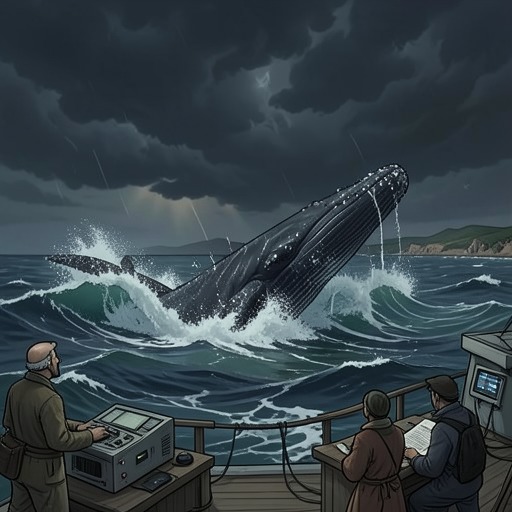
Northern bottlenose whale
The WhaleThe northern bottlenose whale that swam into the River Thames became the focus of an international spectacle and a failed attempt at rescue. Her passage through the capital’s waterways ended near Gravesend, where she died while being carried back toward the sea. The episode brought together the whale’s physical vulnerability, the pressures of a crowded urban environment, and competing human interpretations of what her appearance meant.
Identity and Arrival
In the early twenty-first century, a northern bottlenose whale entered the estuary and travelled upriver, passing beneath Waterloo Bridge and Charing Cross, near the place where Herman Melville had once stayed, and continuing past the Palace of Westminster. She eventually stranded on the Battersea embankment. The route placed a deep-water animal amid the landmarks, traffic, and crowds of a major city, far from the open sea to which she was accustomed.
The whale’s movements followed the tides, taking her up and down the river. Her disorientation and distress were apparent to observers, but the setting also shaped what could be seen: people gathered along the water, boats surrounded her, and helicopters carrying film crews recorded the episode for audiences around the world. The animal was not simply present in the city; she was made into a public event by the attention directed at her.
Rescue and Death
The attempted return began as a public procession toward the sea. The whale was placed on an inflated pontoon and carried downriver, watched by crowds on the bridges and by news crews. The effort did not reverse the conditions that had made her vulnerable. The river led toward the western ocean, but it was also a dead end for an animal that had entered the estuary and could not find her way back to open water.
As the journey continued, the whale’s movements weakened. At seven o’clock that evening, near Gravesend and still two hours from freedom, she died. Her attendants asked that the cameras be turned off as she passed. The request marked a brief limit to the spectacle: after hours of public attention, the people accompanying her sought privacy and respect at the moment when rescue had become impossible.
The necropsy identified dehydration and stress as the causes of death. The account also describes the animal’s exposure to traffic, trains, boats, and people, and the fear caused by those trying to help. The rescue therefore carries a sharp contradiction. Its purpose was to return the whale to the sea, yet the passage through the city brought further disturbance and did not prevent a death attributed to the strain of her circumstances.
Public Meaning and Memory
The whale’s appearance prompted interpretations that reached beyond the immediate rescue. The Sunday Mass reading was from the book of Jonah, and a clergyman connected the biblical story of threatened Nineveh with contemporary concerns about consumption, dwindling oil, global warming, and aggression. In this reading, the whale’s arrival became a possible warning to human society. That interpretation did not explain the animal’s actual condition: the necropsy instead supplied a physical account of her death.
Public responses also pulled in opposite directions. Newspaper commentary treated the episode as a test of humanity, while other commentary saw the whale’s appearance as an indictment of nations that continued whaling in the Southern Ocean. The same animal could thus be presented as evidence of compassion or as an accusation against human exploitation. Her death did not settle that debate; it gave each side a highly visible event around which to argue.
The recovery was compared with the river funeral procession for Winston Churchill, while others regarded the scenes as collective madness. Images of the whale being carried on a pontoon lent the episode a ceremonial quality, and the request to turn off the cameras recalled the tension between public display and respect for a dead animal. The account also connects this spectacle with an earlier beluga kept at the Royal Aquarium, another whale made into a public object and associated with dislocation. In both cases, human attention turned an animal’s presence into an occasion for display and interpretation.
Specimen and Contrast
Months after the death, Richard Sabin showed the narrator the whale’s dorsal fin, preserved in a specimen jar at the Natural History Museum, London. The fin retained a bend attributed to the trauma of the animal’s final days. Removed from the river and kept for study, it became a material record of the encounter: not the living whale, but a part of her body that carried evidence of what she had endured.
The episode is set against the treatment of another bottlenose whale that entered the Humber in 1938. That animal repeatedly grounded and was considered a danger to shipping; Starkey decided to shoot it. The carcass was claimed by the Natural History Museum only after the museum queried the butcher’s charge for gutting it. The contrast is not simply between a cruel past and a humane present. In 1938, shipping danger and the acquisition of a carcass governed the response; in the later episode, public concern and an elaborate rescue shaped events, but the whale still died. Across these accounts, the change in human treatment is real, yet good intentions and public attention could not ensure the animal’s survival.